Project Trailer
Project Overview
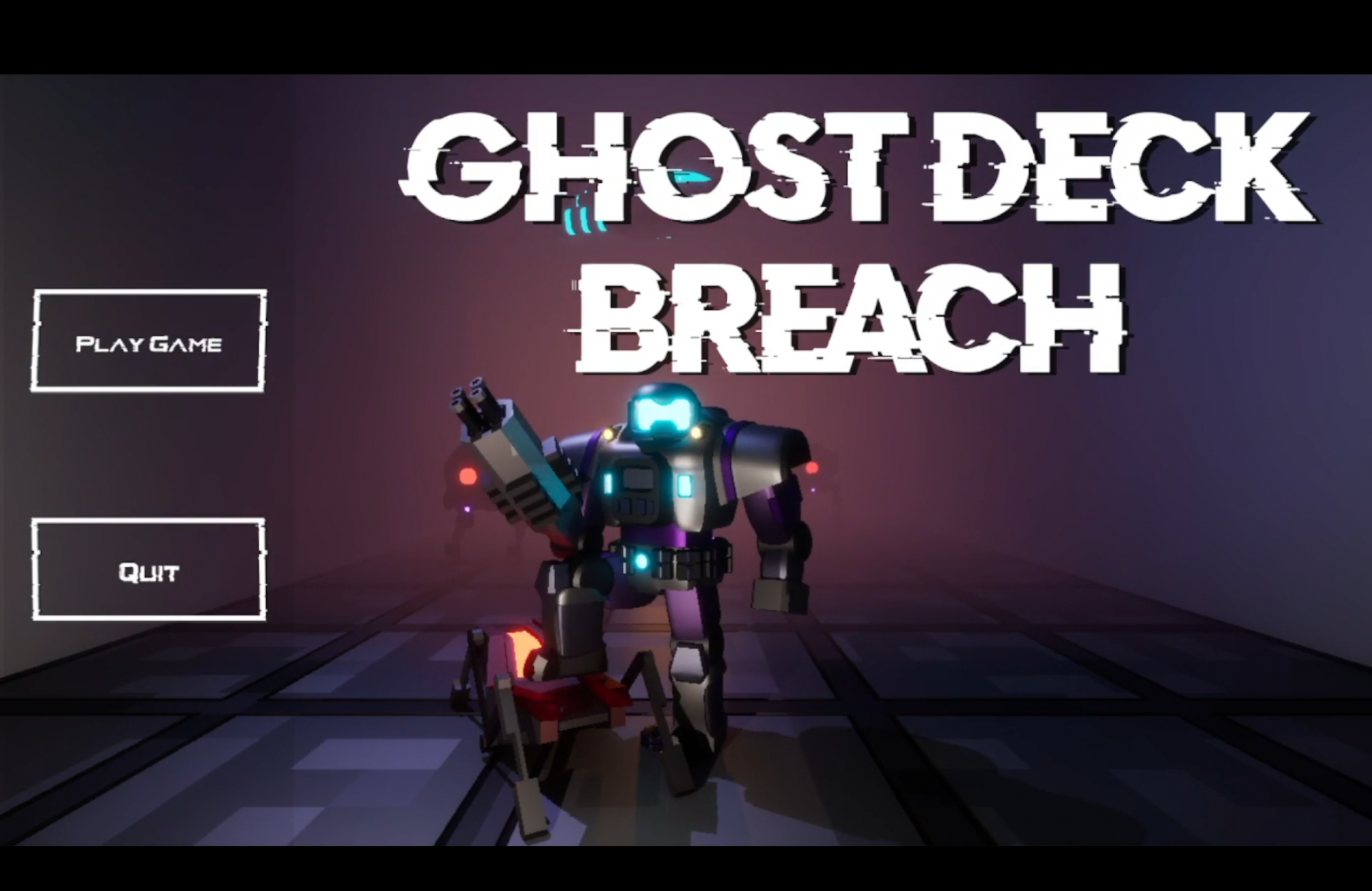
Ghost Deck Breach is a short, focused first-person shooter level developed solo in Unreal Engine 5 over an eight-week period for my second-year Gameplay & Quest Design module.
The project is a 5–10 minute sci-fi FPS experience set aboard a derelict research vessel. The design prioritises readability, pacing, and player clarity, using proven FPS conventions rather than experimental mechanics or cinematic spectacle.
My role covered level design, encounter design, quest structure, pacing, blockout iteration, and player experience tuning.
Design Philosophy & Research Foundation
Rather than relying on abstract design theory, this level is grounded in evidence-based FPS design, drawing directly from established games that demonstrate excellence in readability, combat flow, and pacing.
Key influences include:
- Halo: Combat Evolved – environmental readability and spatial clarity
- Alien: Isolation – atmosphere through restraint and silence
- DOOM (2016) / DOOM Eternal – movement-driven combat arenas
- Titanfall 2 – mobility as a survival tool
- Dead Space 2 & Metro Exodus – high-pressure escape sequences
Each mechanic, space, and quest beat in Ghost Deck Breach is justified by how similar design problems are solved in these titles.
Level Overview & Player Fantasy
The player assumes the role of a Lancer sent to:
- Restore power to a disabled ship
- Retrieve a missing AI core
- Escape before full system shutdown
There are no cutscenes, terminals, or logs. All narrative context is communicated through environmental storytelling, allowing the player to infer events rather than be told explicitly.
This approach keeps focus on moment-to-moment gameplay while reinforcing immersion and tone.
Quest & Mission Structure
The level is divided into five clearly structured quests, designed to be immediately understandable and to flow naturally into one another. This mirrors the clean objective pacing seen in games like Destiny 2.
Quest 1 – Restore Power (~2 minutes)
Purpose
- Onboard the player safely
- Introduce interaction mechanics
- Establish environmental tone
Design Approach
- Distance-based tracking subtly guides the player
- No combat pressure, allowing space awareness to develop
Quest 2 – Breach the Main Corridor (~2–3 minutes)
Purpose
- Teach the core combat loop
- Introduce kill-tracking objectives
Design Approach
- Small-scale encounters with clear sightlines
- Real-time quest updates reinforce cause-and-effect
- Progression is locked until threats are cleared, reinforcing mastery
Quest 3 – Reach the AI Core (~1–2 minutes)
Purpose
- Slow pacing slightly
- Introduce light problem-solving and scavenging
Design Approach
- Simple environmental puzzle (power rerouting)
- Encourages exploration without breaking flow
Quest 4 – Defend the AI Core (60 seconds)
Purpose
- Deliver the level’s peak combat challenge
- Test movement mastery
Design Approach
- Circular arena with four enemy entry points
- Continuous pressure encourages aggressive repositioning
- Designed as a Doom-style survival loop
Quest 5 – Escape the Ship (90 seconds)
Purpose
- Final intensity spike
- Deliver urgency and closure
Design Approach
- Fully linear route to eliminate hesitation
- Strong leading lines guide movement instinctively
- No optional paths or distractions
This structure creates a clear escalation curve, ensuring tension builds deliberately rather than randomly.
Gameplay Mechanics Supporting Design
Movement
- Walk
- Jump
- Crouch
- Gravity Dash (6-second cooldown)
The Gravity Dash is inspired by Titanfall 2’s movement philosophy. It encourages short-burst mobility, allowing players to recover from mistakes without trivialising combat.
Combat Tools
- Pistol – reliable mid-range option
- Ion Shotgun – high-risk, high-reward close-range weapon
- Laser Sword – dependable melee fallback
This limited but versatile loadout keeps decision-making readable while supporting varied encounter design.
Encounter & Arena Design
Combat spaces were built to:
- Promote movement
- Prevent static cover play
- Maintain clear sightlines
Key examples:
- Security Hall redesigned with cover “islands” to force repositioning
- AI Core Chamber rebuilt as a circular combat bowl supporting multi-angle pressure
Enemy behaviour follows a clear, readable FSM:
Patrol → Detect → Chase → Attack → Reset
This ensures encounters feel tense but fair, allowing players to learn patterns and improve.
Iteration & Blockout Development
The level went through three major layout iterations:
Iteration 1 – Functional Blockout
- Identified boxy spaces
- Poor AI navigation
- No exploration incentives
Iteration 2 – Gameplay Expansion
- Added armory and storage rooms
- Improved cover placement
- Widened corridors for combat flow
Iteration 3 – Final Layout
- Combat arenas rebuilt for clarity
- Escape route simplified to fully linear
- Reduced cognitive load during high-stress moments
Each iteration was driven by playtesting feedback, not personal preference.
UX & HUD Design
The HUD is inspired by Halo’s minimalist approach:
- No minimap
- No flashing indicators
- No unnecessary UI noise
Key information is always visible, readable, and unobtrusive, supporting immersion and fast decision-making.
Reflection & Key Learning
This project reinforced how critical clarity, pacing, and restraint are to effective gameplay design. Working solo within an eight-week timeframe highlighted the importance of:
- Locking scope early
- Designing for player comprehension first
- Iterating layouts based on playtesting, not assumption
I learned that strong gameplay design is often about removing confusion, not adding complexity.
What I Would Improve Next
With additional time, I would:
- Add optional risk-reward side rooms
- Introduce enemy variants to deepen combat variety
- Expand environmental storytelling through animated props
- Add difficulty modifiers to support replayability
Outcome
Ghost Deck Breach demonstrates my ability to:
- Design clear, readable FPS levels
- Structure quests that support pacing and learning
- Iterate layouts based on player feedback
- Balance tension, movement, and fairness
Together with my Monopoke systems project, this level represents my approach to holistic game design—where systems, spaces, and player experience reinforce one another.